
If you’re comparing options for a bathroom remodel, walk in tub water usage is probably one of the first practical questions on your mind, right alongside safety and cost. How many gallons does a walk-in tub actually hold? How long do you wait for it to fill, and how long before you can safely open the door and step out? These are fair questions, especially if you’re on municipal water and sewer billing here in Columbus.
The good news is that modern walk-in tubs are engineered to answer every one of those concerns. Below we break down five facts about walk in tub water usage — fill volume, fill time, drain time, water heater sizing, and how it all compares to a standard tub or shower — so you can plan your Columbus bathroom remodel with real numbers instead of guesswork.
Walk-In Tub Water Usage: How Many Gallons Per Bath?
Most walk-in tubs use somewhere between 40 and 80 gallons of water per soak, depending on the model, seat height, and whether the tub includes hydrotherapy jets. Compact soaking models on the lower end of that range are popular for smaller bathrooms, while deeper soaker and bariatric models built for taller users or those who want water up to shoulder level land closer to 80 gallons.
That range matters because it’s the number every other fact in this article builds on. Once you know roughly how many gallons your chosen tub holds, you can estimate fill time, check your water heater’s capacity, and get a realistic sense of what your tub will add to your monthly utility bill.
- Compact soaking tubs: roughly 40–50 gallons
- Standard walk-in tubs with hydrotherapy jets: roughly 50–65 gallons
- Bariatric or extra-deep soaker models: roughly 65–80+ gallons
Tub capacity is also tied to your bathroom’s footprint. A compact 40-gallon soaking model can often slide into the same alcove as your old bathtub, while a deeper 70- to 80-gallon bariatric tub may call for a wider door swing or slightly larger drain line to handle both the higher volume and the faster drain rate. When our estimators measure your bathroom, they factor gallons, floor space, and existing plumbing together so the tub you choose fits the room and performs the way the spec sheet promises.
Manufacturer spec sheets list gallon capacity at the model’s maximum fill line, which is rarely how most people actually bathe. In practice, most homeowners fill to a seated shoulder or chest height and leave a few inches of headroom below the overflow drain, so real-world usage often lands a bit below the published maximum for any given model.
Fact 1: Typical Fill Times (and Fast-Fill Faucets)
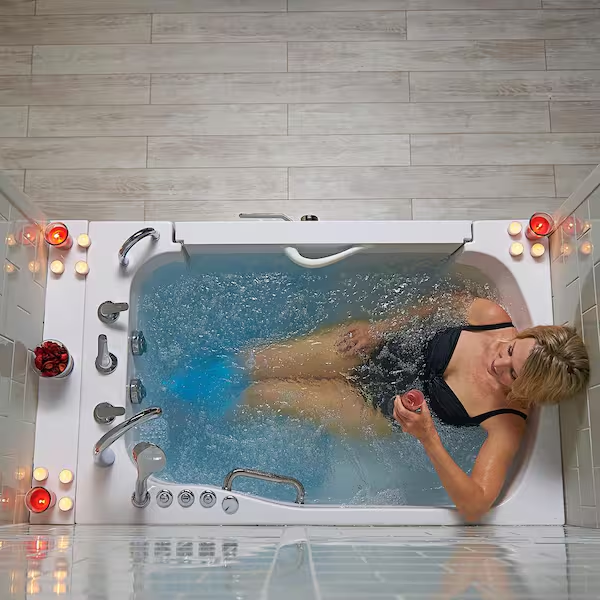
A standard bathtub faucet delivers around 4 to 5 gallons per minute, which means filling a 60-gallon walk-in tub the old-fashioned way could take 12 minutes or more — a long time to sit in a cold, empty tub with the door sealed. That’s exactly why reputable walk-in tub manufacturers build in fast-fill faucets rated for 8 to 12+ gallons per minute.
With a true fast-fill faucet, that same 60-gallon tub fills in roughly 5 to 7 minutes, and smaller compact models can fill in as little as 3 to 4 minutes. If a fill time isn’t clearly specified on a manufacturer spec sheet, ask directly — it’s one of the easiest ways to compare walk in tub water usage and comfort across brands before you buy.
Older Columbus homes can add a wrinkle here. Houses built before the 1980s sometimes have 1/2-inch supply lines and lower static water pressure than newer construction, which can stretch a fast-fill faucet’s rated time by a minute or two. It’s not a dealbreaker, but it’s exactly the kind of detail worth checking during a home visit rather than discovering on your first soak.
Ella’s Bubbles is one of the few brands that publishes real fast-fill flow rates on its product pages instead of burying the number in fine print. If fill speed is a top priority for you, it’s worth reviewing Ella’s Bubbles fast-fill walk-in tubs to see which faucet and pump configuration fits your household.
Fact 2: Drain Times and Why Dual Drains Matter
Drain time is where a lot of older or budget walk-in tubs fall short. A single 1.5-inch drain moves water out slowly, which means you could be sitting in cooling, dirty water for 5 to 8 minutes after you’re ready to get up — not exactly ideal, and potentially unsafe for anyone with mobility or balance concerns.
Dual-drain systems solve that problem by opening two drain paths at once, cutting typical drain time down to roughly 2 to 4 minutes for most models. Some rapid-drain configurations pair a dual drain with a built-in pump to clear the tub even faster, which is a meaningful safety upgrade for seniors and anyone managing arthritis, limited mobility, or a fear of falling.
When you’re evaluating fill and drain performance together, drain speed deserves just as much attention as fill speed. A tub that drains quickly gets you back on your feet sooner and reduces the time spent exposed to a cooling bath.
Fact 3: Will Your Water Heater Keep Up? (Sizing Guidance)
This is the question we hear most often from Columbus homeowners: “Will my water heater run out of hot water halfway through filling my new tub?” The honest answer depends on your tank size and recovery rate, but here’s the general guidance we give during every in-home consultation.
A standard 40- to 50-gallon gas or electric tank water heater can typically supply one full walk-in tub soak, though the water may run slightly warm rather than hot by the final few gallons on larger 70–80 gallon fills. Tankless (on-demand) water heaters generally perform better for walk-in tubs because they don’t run out of stored hot water — they just need to be sized for the incoming flow rate of a fast-fill faucet, typically 8 GPM or higher.
If you’re planning a custom walk-in tub installation in Columbus and you currently have an older or smaller tank water heater, it’s worth discussing an upgrade at the same time. Our installers regularly evaluate water heater capacity as part of every custom walk-in tub installation in Columbus so you’re not caught off guard by a lukewarm bath on day one.
Upgrading isn’t always necessary, and it isn’t always cheap, so we treat it as an optional add-on rather than a default recommendation. A larger 50-gallon tank swap is a modest cost compared with the tub installation itself, while a whole-home tankless unit is a bigger investment that typically pays off in lower standby energy use over time. Either way, we’d rather flag the water heater question during your consultation than have you find out the hard way on your first soak.
Fact 4: Walk-In Tub vs. Standard Tub vs. Shower Water Use
Here’s how walk in tub water usage actually stacks up against the other bathing options in your home:
- Standard tub bath: roughly 30–45 gallons per fill, depending on tub depth and how full you run it
- Walk-in tub bath: roughly 40–80 gallons, since the seated design and higher water line require more volume for a full soak
- Shower (8 minutes): roughly 16–20 gallons with a WaterSense-certified showerhead flowing at 2.0 gallons per minute, or up to 20+ gallons with an older, non-certified 2.5 GPM showerhead
Those shower figures aren’t a guess — they’re based on published EPA WaterSense water-use standards, the federal program that certifies fixtures for verified water efficiency. The EPA’s own research shows that WaterSense-labeled showerheads use at least 20% less water than the federal maximum flow rate without sacrificing pressure or performance.
So yes, a walk-in tub soak generally uses more water per session than a quick shower. But it’s a fair trade for many homeowners: a full-body soak with hydrotherapy jets delivers therapeutic and mobility benefits that a shower simply can’t, and most people don’t take a walk-in tub soak every single day the way they shower.
Put in perspective over a full month, a household that takes three walk-in tub soaks a week at 60 gallons each uses roughly 720 gallons monthly just for those soaks — less than the water a single older, inefficient toilet can use in flushes over the same period. Compared against total household water use, which the average U.S. home puts at several thousand gallons a month, a few weekly soaks are a small line item rather than a budget-breaker.
Fact 5: What It Means for Your Columbus Utility Bill
Columbus-area households typically pay a combined water-and-sewer rate that lands somewhere in the range of $10 to $20 per 1,000 gallons, though your exact rate depends on your provider and usage tier. Using that range, an 80-gallon walk-in tub soak costs roughly 80 cents to $1.60 in water and sewer charges per fill — plus a modest amount for the energy used to heat that water.
Even homeowners who soak several times a week are typically looking at a few extra dollars a month, not a dramatic spike on their utility bill. If keeping costs predictable matters to you, our walk-in tub pricing calculator can help you estimate both the installation investment and typical ongoing costs before you commit to a model.
A few Columbus-area utilities also offer conservation programs, rebates on WaterSense-labeled fixtures, or tiered rates that reward lower overall household usage. Pairing a new walk-in tub with a WaterSense-certified showerhead and faucet aerators elsewhere in the home is a simple way to offset the extra gallons from soaking, so your total household water use stays roughly where it was before the remodel.
Features That Fix the Fill/Drain Objection (Ella’s Fast-Fill and Dual Drain)
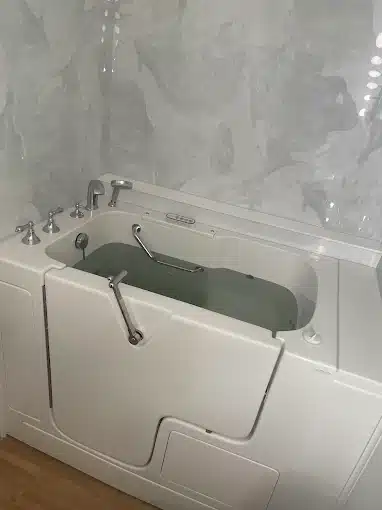
If concerns about walk in tub water usage, fill time, or drain speed have been holding you back, it helps to know that the objection has already been engineered away by better manufacturers. Ella’s Bubbles walk-in tubs are built specifically around this pain point, combining fast-fill faucets with dual or rapid-drain technology so you’re never stuck waiting in an empty or cooling tub.
Here’s what to look for when you’re comparing models:
- A fast-fill faucet rated 8 GPM or higher
- Dual or rapid drain configuration rated to clear the tub in under 4 minutes
- A low, quick-seal entry door that doesn’t require the tub to be completely full or empty before it’s safe to open
- An anti-scald valve to protect against temperature swings during fast fills
These same features are especially valuable for older adults living independently, which is part of why walk-in tubs remain such a popular safety upgrade. We cover the broader safety case in more detail in our guide to walk-in tubs for seniors, including how fast fill and drain times factor into fall-prevention planning.
And because every tub eventually needs a check-up — a faucet aerator to clean, a drain valve to inspect, a door seal to replace — it’s worth choosing an installer that sticks around after the sale. Our team handles ongoing walk-in tub service and repair for every unit we install, so fill and drain performance stays consistent for years, not just on installation day.
5 Practical Tips to Manage Fill Water Without Sacrificing Comfort
If you’d like to keep gallons-per-soak on the lower end without giving up the experience, a few small habits go a long way:
- Fill to seated shoulder height, not the overflow line. Most soaks feel just as relaxing a few gallons short of a completely full tub.
- Run the fast-fill faucet at full flow. A partially open valve takes longer and can actually use slightly more water waiting for temperature to stabilize.
- Pair hydrotherapy jets with a shorter fill. Jets recirculate water rather than adding more, so you get the full massage effect without topping off the tub.
- Set your water heater’s thermostat around 120°F. This reduces the need to add extra hot water partway through a soak to compensate for a lukewarm tank.
- Schedule an annual check on faucet aerators and the drain assembly. A worn seal or slow drain can quietly waste water and add to both fill and drain time.
- Ask about a low-flow overflow drain. Some models route excess fill water straight to the overflow rather than letting it run past the rim, so nothing extra is drawn from the supply line.
None of these tips require sacrificing comfort — they’re simply small adjustments that keep your walk-in tub running the way it was designed to, without turning bath time into a chore you have to think about.
FAQ: Walk In Tub Water Usage
Do you sit in the tub while it fills?
Yes. Because the door seals before the water starts flowing, you sit down inside the tub first, close and lock the door, and then start the fast-fill faucet. This is standard for every walk-in tub on the market and is exactly why fill time matters so much — a fast-fill faucet means less time sitting in an empty, dry tub waiting for warm water to arrive. Most homeowners get used to the routine within their first one or two soaks.
How long until I can open the door?
You can only safely open the door once the tub has fully drained, which is why drain speed is such a practical part of walk in tub water usage. With a dual-drain system, most models clear in roughly 2 to 4 minutes after you pull the drain lever, compared with 5 to 8 minutes for a single-drain setup. If your tub is taking noticeably longer than that to clear, it’s usually a sign the drain valve or line needs a quick inspection.
Do walk-in tubs waste water?
Not in any meaningful sense. A walk-in tub soak uses somewhat more water than a quick shower, similar to or slightly more than filling a standard tub, but it’s a one-time, intentional fill rather than continuous running water. Most manufacturers also design fast-fill faucets to minimize overflow and standing time, and features like dual drains mean no water sits unused any longer than necessary. For most households, the added gallons are a small trade-off for a safer, more therapeutic bathing routine.
Still weighing your options? Our Columbus-based team can walk you through real gallons-per-fill numbers, fill and drain times, and water heater compatibility for any model you’re considering. We measure your bathroom, review your existing plumbing and water heater, and recommend a tub size that matches how you actually plan to use it — whether that’s a quick daily soak or a longer hydrotherapy session a few times a week. Reach out today and we’ll help you plan a walk-in tub that fits both your bathroom and your utility bill.